
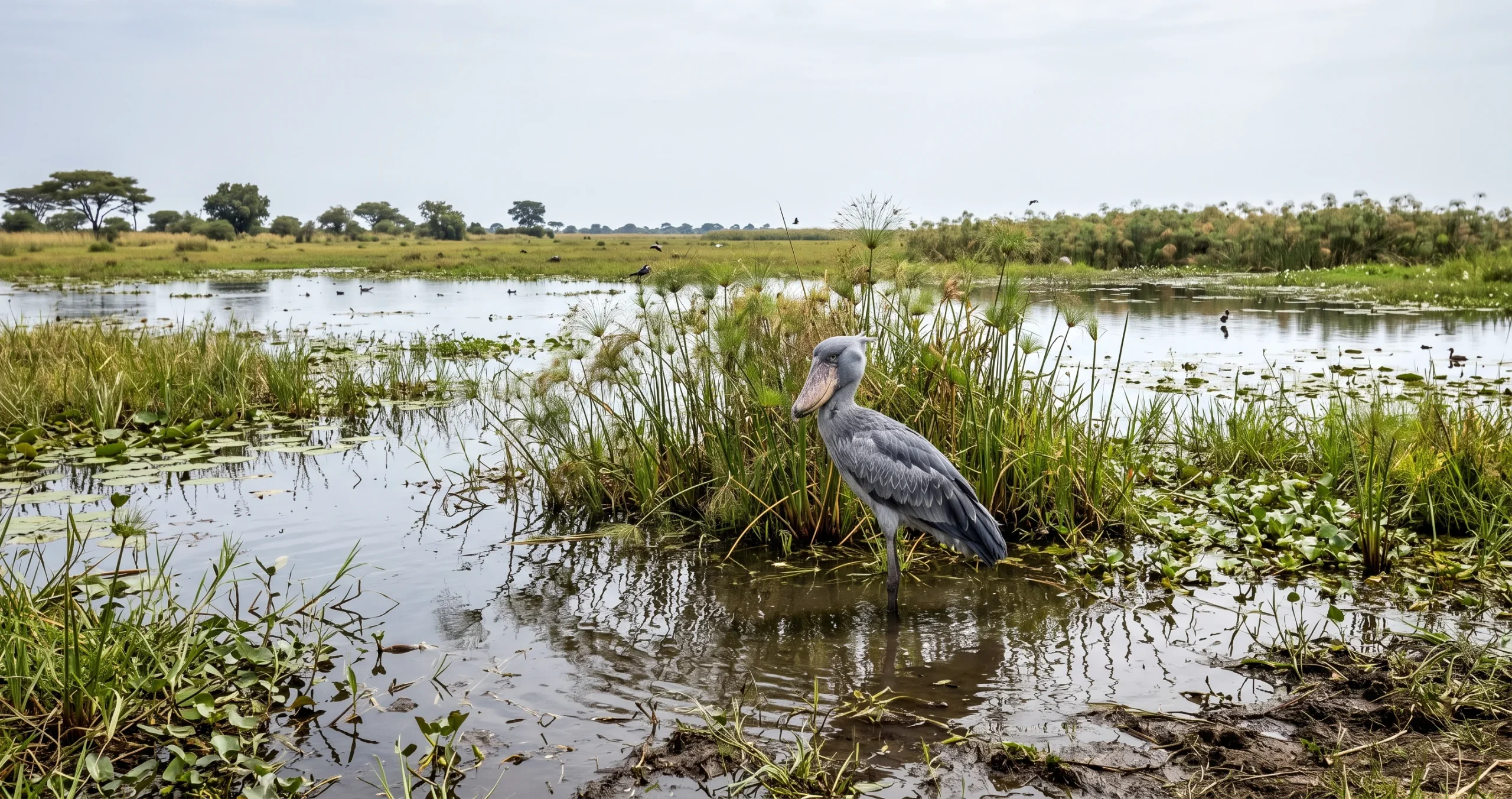
Few birds can turn doing absolutely nothing into such an effective hunting strategy. In the freshwater wetlands of tropical Africa, the shoebill can remain almost perfectly still, watching the water until prey drifts within striking distance. This extraordinary shoebill stork hunting behavior combines patience, precise vision, a powerful neck, and one of the most formidable bills in the bird world.
Despite the familiar nickname “shoebill stork,” the shoebill (Balaeniceps rex) is not a true stork. Its strange proportions, gray plumage, intense stare, and enormous shoe-shaped bill have given it an almost prehistoric reputation, but the real animal is even more interesting than the myths surrounding it.
Table of Contents
- What Is a Shoebill?
- Shoebill Stork Hunting: The Art of Standing Still
- How Long Can a Shoebill Remain Motionless?
- The Massive Bill and How It Works
- What Shoebills Eat
- Why Lungfish Are Ideal Prey
- Why Shoebills Look Prehistoric
- Is the Shoebill Really a Stork?
- Life in African Wetlands
- Conservation Status and Threats
- Common Shoebill Myths
- Frequently Asked Questions
- Conclusion
What Is a Shoebill?
The shoebill is a huge wetland bird native to tropical Africa. It inhabits freshwater swamps and marshes, particularly landscapes dominated by papyrus, reeds, grasses, and other dense aquatic vegetation.
Adults can reach roughly 152 centimeters, or about five feet, in height. BirdLife International reports average weights of around 4.9 kilograms for females and 5.6 kilograms for males.
Yet height is rarely the first thing people notice. The bird’s head is dominated by an enormous, broad bill that resembles an old-fashioned wooden shoe.
Its pale eyes, shaggy crest, long legs, slate-gray feathers, and deliberate movements complete an appearance unlike that of almost any other living bird.
Shoebill Stork Hunting: The Art of Standing Still
The most remarkable part of shoebill stork hunting is how little movement it can involve.
Shoebills are classic ambush predators. Instead of constantly chasing fish through the water, they frequently use a “stand-and-wait” technique, positioning themselves near productive shallow water and watching.
A feeding shoebill may hold its head and bill pointed downward while scanning for movement. Its body remains extraordinarily quiet, reducing the chance that nearby prey will detect the predator before it attacks.
The strategy is particularly effective in swampy areas where fish periodically approach the surface.
Once a suitable animal moves into range, everything changes.
The shoebill rapidly thrusts forward and downward in a powerful movement sometimes described as a “collapse.” The whole body contributes to the strike, transforming a motionless bird into an explosive predator in seconds.
The San Diego Zoo describes shoebills as stand-and-wait or extremely slow-moving hunters and notes that their reinforced bills are important because the bill absorbs considerable force during these forward strikes.
That contrast between prolonged stillness and sudden acceleration is the key to successful shoebill stork hunting.
How Long Can a Shoebill Remain Motionless?
Claims about shoebills sometimes become exaggerated online, with precise hour counts presented as though every bird follows a stopwatch.
The safer scientific description is that shoebills can remain motionless for exceptionally long periods. BirdLife International specifically reports that they can remain “still as a statue for hours” while waiting for prey.
Not every period of stillness necessarily represents active hunting. Shoebills also rest, and simply seeing an unmoving bird does not reveal exactly what it is doing.
Stillness nevertheless provides an obvious advantage during an ambush.
Every unnecessary step creates movement and disturbance in the water. By waiting, the shoebill allows potential prey to approach rather than wasting energy pursuing it.
This patient lifestyle makes the shoebill a striking example of how predators can succeed through timing rather than continuous speed.
![“shoebill stork hunting motionless in a papyrus wetland while waiting for fish”]](https://tesourosdojardim.com/wp-content/uploads/2026/09/Gemini_Generated_Image_ejfjllejfjllejfj-1024x541.webp)
The Massive Bill and How It Works
A shoebill’s bill looks oversized even on such a large bird, but its proportions make sense when the hunting technique is considered.
The bill is broad, deep, strong, and equipped with sharp cutting edges. Its upper mandible ends in a prominent hooked tip that helps secure slippery prey.
During shoebill stork hunting, the bird does not always grab a perfectly clean mouthful of fish.
A strike can scoop up water, plants, mud, and prey together. The shoebill then manipulates the contents, discarding unwanted vegetation before positioning and swallowing its catch.
According to the San Diego Zoo, those sharp bill edges can help dispatch prey and separate vegetation caught during a strike.
The bill serves other purposes as well. Shoebills use bill clattering for communication, and adults can even carry water in the bill to cool eggs or chicks.
Its most spectacular function, however, remains capturing relatively large aquatic animals.
What Do Shoebills Eat?
Fish make up an important part of the shoebill’s diet.
Lungfish are especially associated with the species, but shoebills also take catfish, tilapia, and other fish. Depending on availability, they may capture frogs, water snakes, monitor lizards, turtles, and occasionally other vertebrates.
Reports of young crocodiles in the diet are not simply an internet invention. Both BirdLife and zoo references document small crocodilians among the prey shoebills can take, although this should not be mistaken for their everyday primary food.
Fish remain much more representative of the shoebill’s normal diet.
This distinction matters because dramatic footage can distort how people perceive wildlife. A rare or unusual prey event may spread widely online even when it represents only a small part of an animal’s feeding ecology.
Why Lungfish Are Ideal Prey
Lungfish are particularly interesting in the story of shoebill stork hunting because their physiology can make them accessible to a patient surface predator.
African lungfish possess true lungs and breathe atmospheric air in addition to using gills. Some species depend heavily on air breathing and must periodically reach the surface.
Shoebills often forage in shallow, slow-moving wetlands, including low-oxygen environments.
In such conditions, air-breathing fish surfacing to breathe may become vulnerable to a predator waiting silently above them. The shoebill does not need to pursue the fish underwater; it can wait for an opportunity to come within striking range.
This illustrates how predator anatomy, prey physiology, and wetland conditions interact.
The bird’s stillness, downward gaze, rapid strike, and enormous bill form a hunting system well suited to these environments.
Why Does the Shoebill Look Prehistoric?
Calling a shoebill “prehistoric-looking” is understandable.
Its giant head, massive hooked bill, towering body, gray feathers, and penetrating stare create an appearance that seems almost reconstructed from another geological era.
But “prehistoric” is a description of appearance, not a scientific classification.
Shoebills are modern birds. Like all living birds, their deeper evolutionary ancestry ultimately connects to theropod dinosaurs, but the shoebill is not uniquely a “living dinosaur” compared with other birds.
Its unusual appearance reflects specialized evolution for its present ecological niche.
Readers interested in another animal commonly given a dramatic nickname can explore our guide to the “immortal” jellyfish and its remarkable aging reversal. That species provides another useful example of how extraordinary real biology can become distorted when a catchy nickname is interpreted too literally.
Is the Shoebill Really a Stork?
No. This is one of the most persistent misconceptions about the species.
The name “shoebill stork” remains widespread, and older classifications associated the bird with storks. Modern taxonomy, however, places Balaeniceps rex in its own family, Balaenicipitidae, within the order Pelecaniformes.
Evidence places shoebills closer to pelicans than to true storks. BirdLife specifically notes that calling the species a stork is incorrect, even though the traditional name persists.
The shoebill is also unusual taxonomically because Balaeniceps rex is the only living species in its family.
So the bird’s strange appearance is matched by a rather distinctive position on the avian family tree.
Life in African Wetlands
Shoebills depend on extensive freshwater wetlands in eastern and central tropical Africa.
Their range stretches broadly from South Sudan and Ethiopia southward through areas including Uganda, the Democratic Republic of the Congo, Tanzania, and Zambia. BirdLife describes the species as strongly associated with large freshwater swamps containing papyrus, reeds, grasses, and similar vegetation.
These habitats provide much more than fish.
Dense vegetation offers nesting material and secluded breeding sites, while shallow wetland margins create suitable feeding areas.
Shoebills are generally solitary feeders. Even members of a breeding pair may forage separately rather than remaining side by side.
That dependence on particular wetland conditions also creates vulnerability. When swamps are drained, burned, converted, heavily disturbed, or hydrologically altered, a shoebill can lose both feeding and breeding habitat.
Conservation Status and Threats
The shoebill is currently classified as Vulnerable. BirdLife reports an estimated 3,300 to 5,300 mature individuals, with the overall population considered to be declining.
Habitat degradation and loss are major concerns.
Wetlands can be converted for agriculture, affected by livestock, altered by water management, damaged by fire, or disrupted by other human activities. Climate-related changes to drought and wetland hydrology can add further pressure.
Direct human disturbance creates additional problems, particularly around nesting sites.
Hunting, egg collection, and capture for the live-bird trade have also been identified as threats. Illegal capture can be especially damaging for a naturally uncommon species with a restricted wetland distribution and relatively slow reproduction.
Protecting shoebills therefore means protecting functioning wetlands, not simply individual birds.
Healthy marshes support fish, amphibians, reptiles, insects, aquatic plants, and many other birds. Shoebill conservation consequently overlaps with the protection of entire wetland ecosystems.
For a broader example of how animal behavior depends on intact habitats, see our article on elephant infrasound communication, which explores how environmental conditions influence long-distance communication in another iconic African animal.
Common Myths About Shoebills
Myth 1: Shoebills are dinosaurs
Shoebills are modern birds.
Their prehistoric appearance is visually striking, and birds as a group evolved from theropod dinosaur ancestors, but shoebills are not surviving non-avian dinosaurs.
Myth 2: Shoebills are true storks
Despite the common name “shoebill stork,” modern classification does not place them among true storks.
They belong to the family Balaenicipitidae and are more closely allied with pelicans.
Myth 3: Shoebills spend all day completely frozen
Shoebills can remain remarkably still for long periods, especially while hunting, but they obviously walk, fly, preen, communicate, breed, defend territories, and care for young.
Their famous stillness is a behavioral strategy, not a permanent state.
Myth 4: Shoebills mainly hunt crocodiles
This myth probably survives because a huge bird attacking a crocodilian makes memorable imagery.
Shoebills can take young crocodiles, but fish—particularly species such as lungfish—are much more characteristic prey.
Myth 5: Their frightening appearance means they routinely attack humans
The shoebill’s huge bill and intense stare make it easy to portray the species as aggressive.
Its feeding anatomy is primarily specialized for capturing aquatic prey. Wild shoebills should still be given appropriate distance, particularly at feeding and nesting sites, just as other large wild animals should.
Frequently Asked Questions
What is a shoebill?
The shoebill (Balaeniceps rex) is a large African wetland bird and the only living species in the family Balaenicipitidae.
It is famous for its enormous shoe-shaped bill and extremely patient ambush-hunting strategy.
How long can a shoebill stand still?
Shoebills can remain almost motionless for extended periods, and BirdLife reports that they may stay still for hours.
There is no single fixed duration that applies to every hunting attempt.
Why do shoebills stand so still?
Remaining motionless helps a shoebill avoid alerting aquatic prey.
Once an animal moves into a favorable position, the bird can suddenly launch a rapid downward strike.
What does a shoebill eat?
Shoebills primarily eat aquatic prey, especially fish.
Lungfish are particularly well known in their diet, along with catfish and tilapia. Frogs, water snakes, reptiles, and occasionally young crocodiles may also be taken.
Why is the shoebill’s beak so large?
The broad, reinforced bill is adapted for capturing and handling relatively large, slippery aquatic prey.
Its sharp edges and hooked tip help grip and dispatch prey, while its size allows the bird to scoop animals from vegetation-filled water.
Is a shoebill actually a stork?
No.
Although “shoebill stork” remains a common name, Balaeniceps rex belongs to the family Balaenicipitidae within Pelecaniformes and is more closely related to pelicans than to true storks.
Where do shoebills live?
They inhabit large freshwater wetlands in tropical Africa, particularly across parts of eastern and central Africa.
Papyrus swamps, marshes, shallow water, and dense aquatic vegetation provide important feeding and nesting habitat.
Are shoebills endangered?
The species is currently classified as Vulnerable rather than Endangered.
Its population is declining, with habitat loss and degradation, disturbance, hunting, and illegal capture among the recognized threats.
Conclusion
The most impressive feature of shoebill stork hunting is not simply the bird’s enormous bill. It is the combination of anatomy and patience that turns the shoebill into such an effective wetland predator.
For long periods, almost nothing seems to happen. The bird watches the water, minimizes movement, and waits. Then a lungfish or another aquatic animal moves into range, and the apparently frozen hunter launches a powerful strike.
Its massive bill, unusual posture, pale stare, and gray plumage certainly explain the shoebill’s prehistoric reputation. Yet understanding the real animal is more rewarding than treating it as a monster from another age.
The shoebill is a highly specialized modern bird whose survival is closely connected to Africa’s freshwater wetlands.
With only a few thousand mature individuals estimated to remain and populations declining, conserving those wetlands is essential. Protecting the shoebill means preserving the ecological system that makes its extraordinary stand-and-wait lifestyle possible in the first place.
Internal Link Suggestions:
- “How Elephants Communicate Across Miles Using Sounds Humans Can’t Hear” — https://secretsofthegreengarden.com/elephant-infrasound-communication/
- “The ‘Immortal’ Jellyfish That Can Reverse Its Own Aging” — https://secretsofthegreengarden.com/immortal-jellyfish-aging-reversal/
3 External Dofollow Authoritative Sources:
- BirdLife International — Shoebill species profile
https://www.birdlife.org/birds/shoebill/ - San Diego Zoo Wildlife Alliance — Shoebill
https://animals.sandiegozoo.org/animals/shoebill - CITES — Convention on International Trade in Endangered Species of Wild Fauna and Flora
https://cites.org/